From Interfaces to Intent

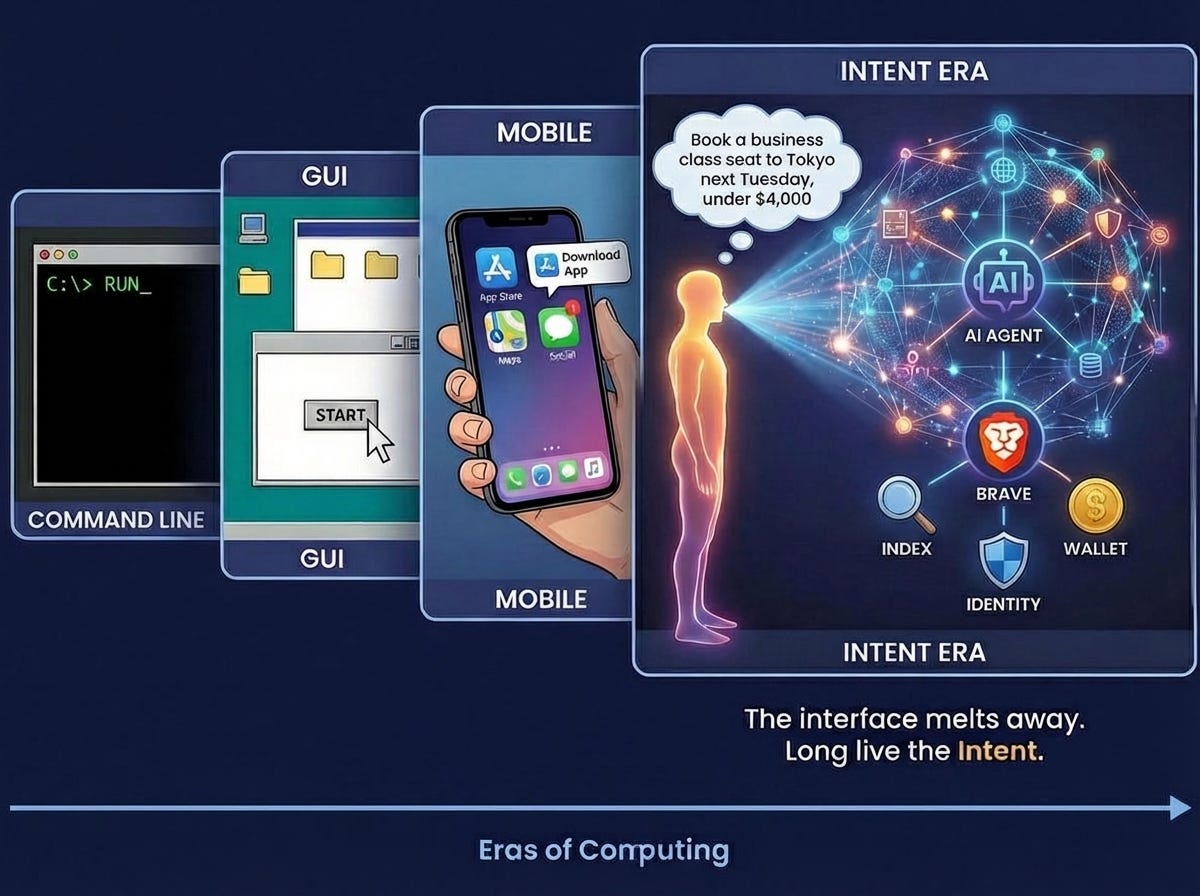
The history of computing is the history of reducing friction.
In the Command Line era, you had to know the syntax. In the GUI era, you had to know which icon to click. In the Mobile era, you had to know which app to download.
We are now entering the Intent Era. In this phase, you don’t navigate; you declare. You don’t click “Expedia,” then “Flights,” then “Search.” You simply state an outcome: “Book me a business class seat to Tokyo next Tuesday, under $4,000, avoiding layovers.”
For the user, this is magic. The interface melts away. For the internet, this is a violent restructuring of power.
When the user stops visiting websites and starts delegating tasks to AI agents, the entire “Front End” of the internet—the buttons, the banners, the meticulously designed landing pages—becomes obsolete. The website is no longer a destination for humans; it is a database for bots.
But this shift reveals a massive, hidden infrastructure crisis.
The Brain Needs Eyes
We have spent the last two years obsessing over the “Brain” of the agent (the LLM). We marvel at how well GPT-4 or Claude can reason. But a brain in a jar cannot navigate the world.
If you ask an AI to “buy me those shoes,” the LLM has a problem. It doesn’t know where the shoes are sold today. It doesn’t know the current price. It doesn’t know if the “Buy” button moved yesterday.
LLMs are frozen in time—trained on data from six months or two years ago. The web, however, changes every second. To execute an intent, an agent needs more than intelligence. It needs a map.
It needs a live, structure-aware, up-to-the-second Index of the entire internet.
The Scarcity of the Map
Here is the strategic reality that few investors understand: There are only three significant, independent search indexes in the Western world.
Google
Bing (Microsoft)
Brave
That’s it. Everyone else—DuckDuckGo, Yahoo, the countless AI startups—is just renting API access from Bing or Google. They are interface wrappers, not infrastructure owners.
This makes the Index one of the scarcest assets in the digital economy.
In the Intent Era, the Index is no longer just for finding links. It is the grounding layer for AI. It is the sensor array that tells the Agent: “This is the URL for the shoes. This is the CSS selector for the ‘Add to Cart’ button. This is the stock status.”
Google knows this. That is why they are choking off API access and poisoning the well for third-party AI. They want their agents to win, so they are hiding the map.
The Brave Advantage: Sovereign Cartography
This puts Brave in a unique position.
Brave is not just a browser; it is one of the only companies on earth that owns its own Search Index. We have crawled billions of pages. We maintain our own map of the web, independent of Big Tech.
This allows us to offer the critical infrastructure that the Agentic Economy needs: Uncensored, API-level access to the state of the web.
While other agents are hallucinating because they can’t see the world, agents running on Brave infrastructure can “see” clearly. They can query the Brave Search API to get real-time data, use the Browser to render the page, and use the Wallet to execute the transaction.
The New Economy of Delegated Action
We are moving from an economy of Attention Capture (keeping you on the site) to an economy of Delegated Action (getting the job done).
In this new world, the value doesn’t accrue to the website with the flashiest design. It accrues to the platform that can best translate Human Intent into Machine Execution.
That requires three things to work in unison:
The Identity (to prove who you are).
The Wallet (to pay for the result).
The Index (to find the destination).
Brave is the only platform that has bundled all three.
We are not just building a better way to view the web. We are building the command center where your intent meets the infrastructure capable of fulfilling it.
The interface is dying. Long live the Intent.